History of Leith, Edinburgh

Follow us on Twitter
Follow us on Facebook Follow us on Facebook

Archive for 2010

The Reoch Monument-South Leith Church

Friday, October 8th, 2010

The Monument which was erected to his memory is without doubt the handsomest in South Leith Church. It occupies the west side of the South Aisle of the church. The top of the memorial is arched to correspond, with the general line of the roof.
The whole is in imitation decorated Gothic, and dated 1848. There is a large centre panel with the inscription, surmounted by a medallion
of James Eeoch and liis crest, with the motto
” Stand.”
On either side are niches with canopies each resting on cherubs.
The niche on the left of the memorial is filled by a figure of ” Charity,” the canopy having the Latin inscription ” Scitamini charitatem.”
The niche on the right is occupied by the figure of Justice, with the inscription “Facite justitiam ” on the canopy above.
These inscriptions are in the form of decorative scrolls, and the canopies are surmounted by pinnacles, on the centre one of which, rests the monogram ” J. E.”
The inscription is as follows :—
” James Eeoch, Merchant, born 1757, died 1845, was Provost of Leith six years, Master of the Merchant Coy. 10 years, and for a long period a member of this Kirk Session. He took an active part in every undertaking for the Benefit and improvement of the Town and Port.
Judicious, energetic, and upright, he possessed public confidence to a high degree. Generous, considerate, singleminded, and accessible to all, he was esteemed as an affectionate and faithful friend. Erected by his fellow-townsmen and others to express their respect for his character, and perpetuate the remembrance of his
worth.
MDCCCXLVIII.”
JAMES EEOCH was born in Leith in November 1757. His father, of the same name, had come to the town from the Parish of Kirkmichael in
Banffshire. He was apprenticed to Charles Cowan, merchant, in the year 1782. Shortly after the expiry of this period of probation, he
became a partner in the firm. In. 1796 he married Isabella Cowan, the daughter of his employer. The Cowans of Penicuik, who founded the famous paper works, were his brothers-in-law. He had three sons and three daughters, of whom, only two were alive when he died. Along with Sir Walter Scott, he had much to do in connection with the landing of George IV. at Leith. Like other Leith merchants, he had interests in many other concerns as well as in his own business. He was
a director of the Edinburgh and Leith Shipping Company, of the Leith Gas Light Company, and of the National Bank. He was also one of
the directors of the National Monument. He was the second Provost of Leith, and occupied that honourable position for two terms, 1839- 1845. When Sir John Gladstone of Fasque presented and endowed the Church of St. Thomas, along with the School and Asylum, he presided at the Dinner given to that well known native of Leith. In that same year the Provost received a handsome present of silver plate from the people of Leith. He had the honour of receiving Queen Victoria and Prince Albert when they landed at Leith on their visit to Scotland in 1842. Not only did he discharge all the duties of the magistracy with dignity and fairmindedness, but he also took a continuous interest in all that concerned the poor, the widow, and the orphan. He died in. his
house in Hope Street, in November 1845, and was buried in South Leith Churchyard. Two of his granddaughters are still living in Inverleith
and there are two great-grandsons, sons of the late James Eeoch, banker.

South Leith Records-1925

Farming in the Restalrig

Friday, October 8th, 2010

From the records of the Land holdings and medieval Charters of Restalrig that we can find not only the names of the farmers who farmed around the area but we can also reconstruct in our minds eye what Rstalrig would have looked like several hundred years ago.

The area around Restalrig for centuries was open fields and unenclosed. There were no hedges or dykes dividing it into separate fields and in fact it was divided into strips and each individual in Leith or Restalrig owned a certain number of strips of land. Just to complicate things a person’ s strip of land could be dotted all over the area and not necessary side by side. This open field system can still be worked out today from a map of the area as the houses now built on the fields follow basically the same plan. So it can be seen that the first large field was around Lochend, the second stretched from Lochend to Easter Road, another from Lochend to the Restalrig Road, and finally from Restalrig Road to Craigentinny. It is obvious that no one person could plough these fields themselves so people had to work together to farm the land. To plough the land wooden ploughs, which was the joint property of the farmers drawn by teams of eight oxen was used. This system existed up the middle of the eighteenth century and from the records of land ownership many of the farmers names are still known going back to the early Middle Ages.

To organise this further the farmers organised open air meetings called the Burlaw Court at what is now Hermitage place in what was called the Docot Park. If the weather was bad then they met at Clephands Tavern in Duke near to what is now Queen Market University College. This ceased in the middle of the Eighteenth century. The purpose of the Burlaw Court was to fix prices, discuss crops etc. There is oddly enough one of these farmers who became world famous or perhaps I should say infamous in the world of literature and that was a gentleman called John Pow. If you visit South Leith Churchyard you can still see his headstone. The story how this came about started in the Nineteenth century before Robert Louis Stevenson left Scotland for ever. As a youth he would visit the Churchyard to see the headstones of his ancestors the Balfours of Pilrig and he passed the headstone of John Pow who died in the Eighteenth century and own the farm at the Laugh at Leith where Leith, St Andrews Church now stands at the foot of Easter Road and stretched between Lochend Road and Hermitage place. According to the records he had twenty-six children and was what was called a Thrawn-man and would argue, moan, complain with everybody.

Not only this but he would sneak out at night and move his neighbours March Stones ( In some cases fields were separated by piles of stones to mark out land ownership) and steal his neighbours hay rigs. Eventually he was thrown out of the Burlaw Court but that didn’t stop him as he took them to Court which lasted for years. Not only this but. when he grazed his sheep on Leith Links for which a rent was paid he always grazed more then what he should have done. Eventually he was thrown out of South Leith Church over the pregnancy of a young woman from the Canongate which of course he denied and became an Episcopalian. However Bishop Forbes (buried in the Maltman’s Aisle at South Leith Church and author of the Lion in mourning about the Jacobite uprising of 1745) records the baptism of the Child at the Laugh at Leith in 1748. It was from John Pow that Stevenson changed to John Pew and used in his story of “Treasure Island” and immortalised him as the blind pirate who gives the black spot to Billy Bones at the Admiral Benbow Inn. As a matter of interest Stevenson took the name “Long John Silver” from the grave of John Silver from the Calton Cemetery which in the early Eighteenth century came under South Leith.

So it is from the records of the Land holdings and medieval Charters of Restalrig that we can find not only the names of the farmers who farmed around the area but we can also reconstruct in our minds eye what Restalrig would have looked like several hundred years ago. We find the names of the freemen who gave military service for their land under the feudal system and the unfree or villains who were tied to the land. Even up to the seventeeth century in old feu charters can be found that payment was made at so many pence Scots and one days work in the fields of the Laird of Restalrig.

A Mortsafe-Greyfriars Churchyard,Edinburgh

Friday, October 8th, 2010


Click to enlarge
(c) John Arthur

Newhaven Main Street

Friday, October 8th, 2010


Click on image to enlarge
(c) John Arthur

Victoria School-Newhaven

Friday, October 8th, 2010


Click on image to enlarge
(c) John Arthur

Remains of the Leith Fort

Friday, October 8th, 2010


Click on image to enlarge
(c) John Arthur

North Leith Church Hall’s Showing Burning Bush Image

Friday, October 8th, 2010


Click on image to enlarge
(c) John Arthur

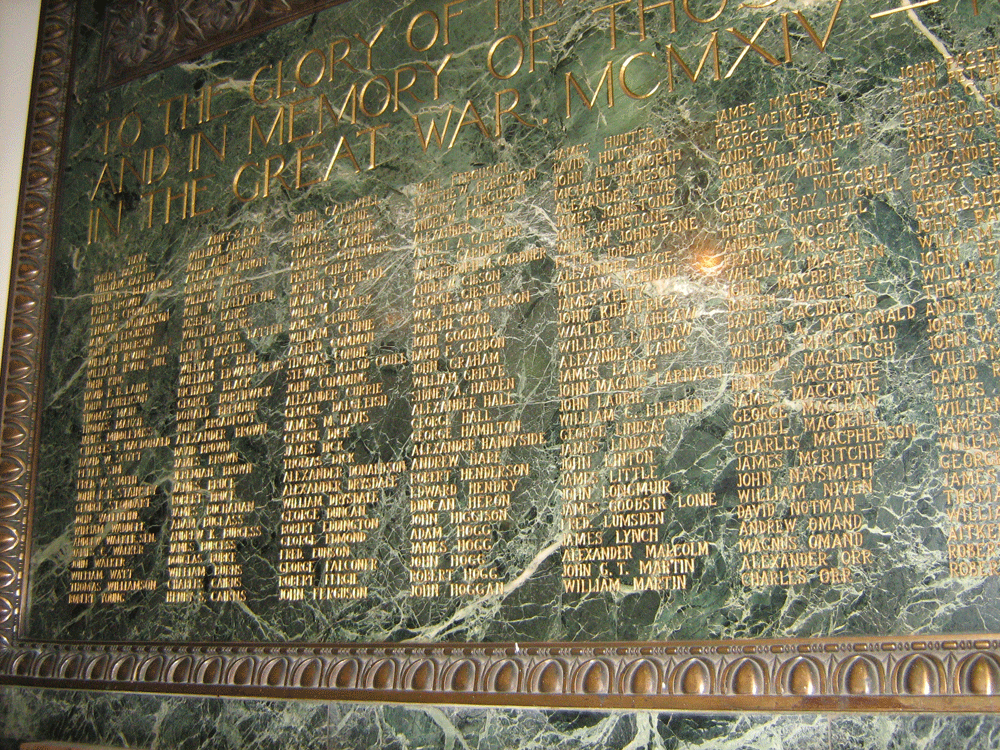
South Leith War memorial

Friday, October 8th, 2010


Click on image to enlarge
(c) John Arthur

Ancient property documents-South Leith Church

Friday, October 8th, 2010


Click on image to enlarge
(c) John Arthur

South Leith Church-East Side

Friday, October 8th, 2010


Click on image to enlarge
(c) John Arthur

Some Text